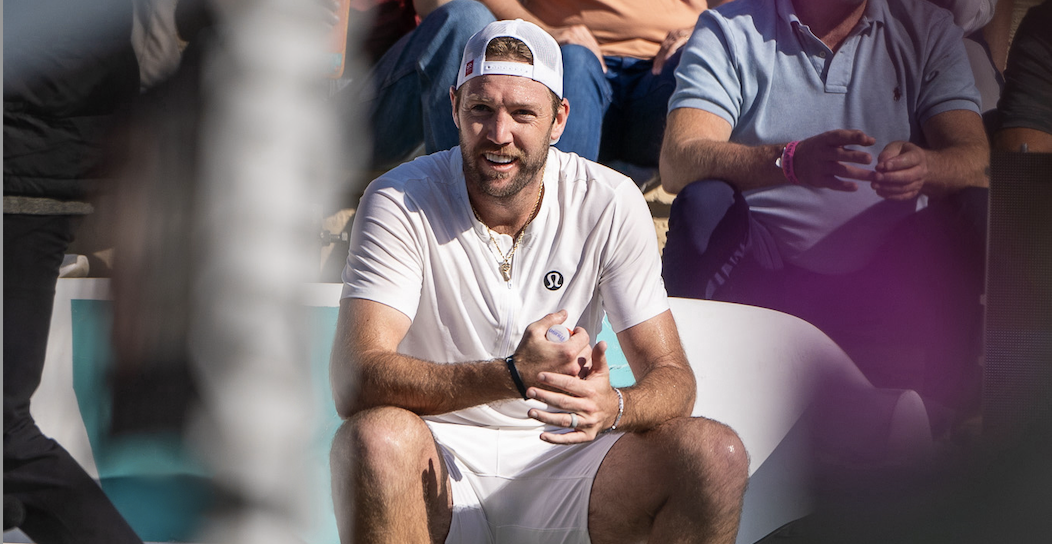
Racquet: The RPMs on your tennis forehand are remarkable [Sock’s forehand rivaled, and sometimes beat, Rafael Nadal’s for spin]. How does having a forehand like yours translate to pickle ball?
JS: It's similar, but not as similar as people think. The groundstrokes are probably the most adaptable and the easiest to get a hold of with a different grip. The paddle, obviously, is much smaller than a racquet, the grip on the paddle is smaller than a tennis racquet, and it's a different grip, especially for me with a full western crazy tennis grip.
But also I think with all the doubles play, and the continental forehand shots you hit in tennis, I was used to [using the volley grip for every shot in pickle ball] already so it wasn't much of a change there. It feels comfortable, but obviously you're not able to grab the ball like you are with strings.
Racquet: I'm trying to get you back on the tennis court, but baby steps: How do we get you onto the padel court?
JS: I love the sport; I probably play maybe a couple times a year but I know it's blown up in in the US more now. I think it's an awesome game. But padel would take a lot more training. Tennis is the hardest sport in the world, padel is kind of in the middle, but pickle ball is a lot harder than people think. I plan on playing pickle ball for as long as I can because I do thoroughly enjoy it. I love it.
Racquet: I'm glad you do, but keep tennis in mind.
JS: Yeah, you never know; maybe some doubles at some point.
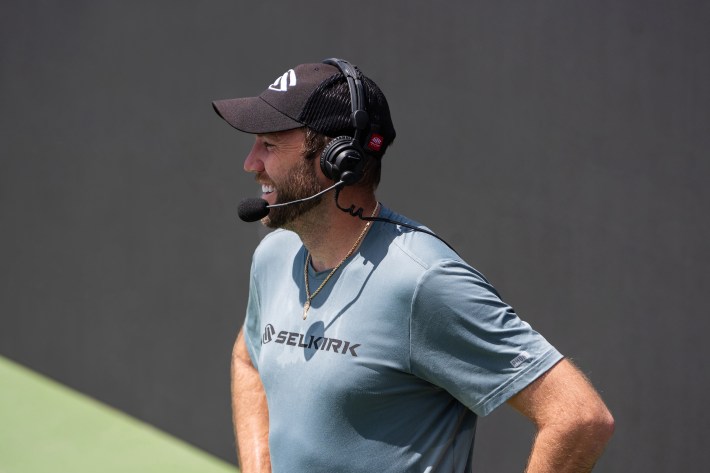
Racquet: Being the subject of a tennis documentary puts you in the ranks with Mardy Fish and Sir Andy Murray, among others. How was it, filming the story of your tennis (and pickle ball) life?
JS: Yeah, when Selkirk and the team approached me with it, I didn't know exactly what it would entail, but it was amazing for me, being in Kansas City and being able to have my family there and some friends from high school and people I grew up with. It was really fun to tell the other the other side of it.
I always find sports documentaries interesting in general; you can take a deeper dive into an athlete’s background and childhood. And it was a lot of fun to do.
Racquet: Did the shift to another sport act as a release valve from the pressure cooker that tennis can be?
JS: Not really. I give a lot of credit to my parents and the people around me growing up, because I had as normal a childhood and high school experience as you can have on that path. I didn't homeschool or start traveling the world for ITFs or living away from home. I played four years of high school tennis, and went to school every day from 8 to 2. I’ll be honest: obviously I heard the noise and the expectations and pressures, but because of that family dynamic, I didn't really think about it much at all. I just loved playing. I’ve always tried to have the perspective to know we're blessed to be able to play tennis for a living. Obviously there’s added stress at times, but at the end of the day, I was able to travel and play for a living, and I tried to have fun on the court.
Racquet: It was obvious that you were having a good time out there. That’s what makes us want you back. So was it the injuries that made you call it a day?
JS: Yeah, probably a combo of things, but the thumb surgery later in my career definitely didn't help. When I started feeling really good again, COVID hit, shutting things down for a while. Even after COVID, I felt like I was getting back to a very high level again, and then the Ukraine-Russia stuff happened, and we weren't getting points for a while. I made the third round of Wimbledon that year, and it would've established me well inside the top 100 and I could've just kept going from there, but instead I was stuck at the challenger level.
Racquet: And that’s when you jumped to pickle ball?
JS: Yes. At that point, I was offered the opportunity to go play pickle ball, and travel less, and be able to compete on a different stage.
Racquet: Is there anything about the tennis tour that you miss?
JS: Yeah, I loved playing in some of the tournaments, and some of the venues. And the crowds. People could probably tell I loved playing in front of as many people as possible. But all those years of travel definitely take a toll, so I don't miss that.
Racquet: How do you feel about this statement: Tennis is chess, pickle ball is checkers?
JS: They're just so different. I don't know if you can compare them. But at the highest level of pickle ball, especially in doubles, I've called it a chess match before; it’s my analogy for it. People think “dinking,” they think it's slower, but it's not. I’d request that people go see it in person and see the split-second thinking (which is obviously in tennis as well). You know, you’re trying to construct points in both sports. So I call them both chess in their own way.